

This issue is a little late because I’ve spent more of the past couple of weeks in the real world, connecting with people and customers, and remembering how much joy that can bring. It feels we live in a time where community and actual time together matter more than ever, and the effort it requires is worth it. Our peers, advisors and customers make us better marketers in ways AI never will.
The week in one minute
What we’re pondering: A marketing factory with taste, what hidden touchpoints will change, and building faster than people can absorb.
What we’re trying: Measuring AEO, digital twins for research, hypercustomized sales decks and a Dragon desktop.
Worth your attention: Conversational ads, agent-ready CRMs, ABM measurement, Jev and a post-conference playbook.
GTME jobs: 871 roles marked Likely Open in our September 29 review.
Stranger than fiction: Competition in AI is reaching another level.
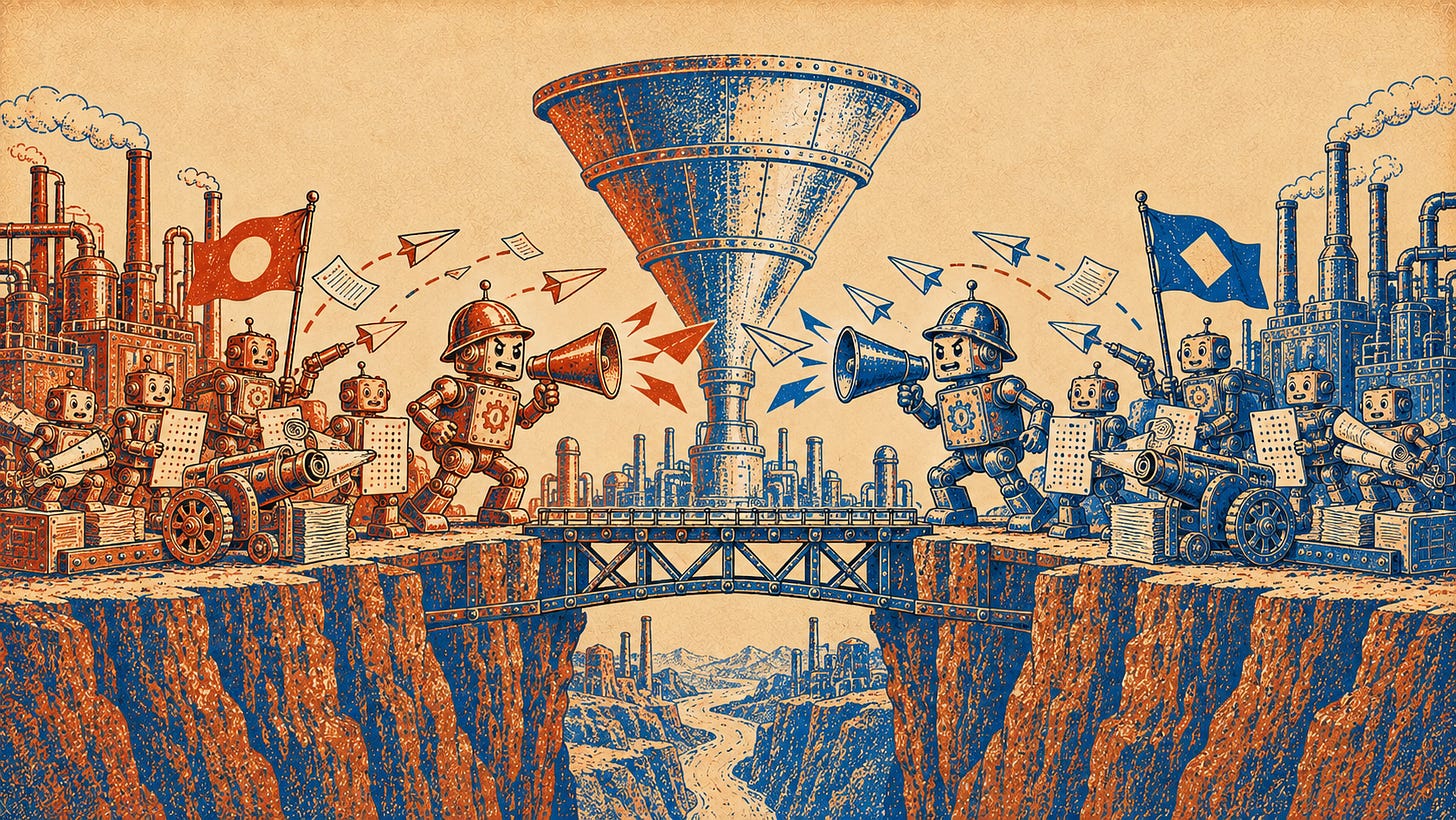
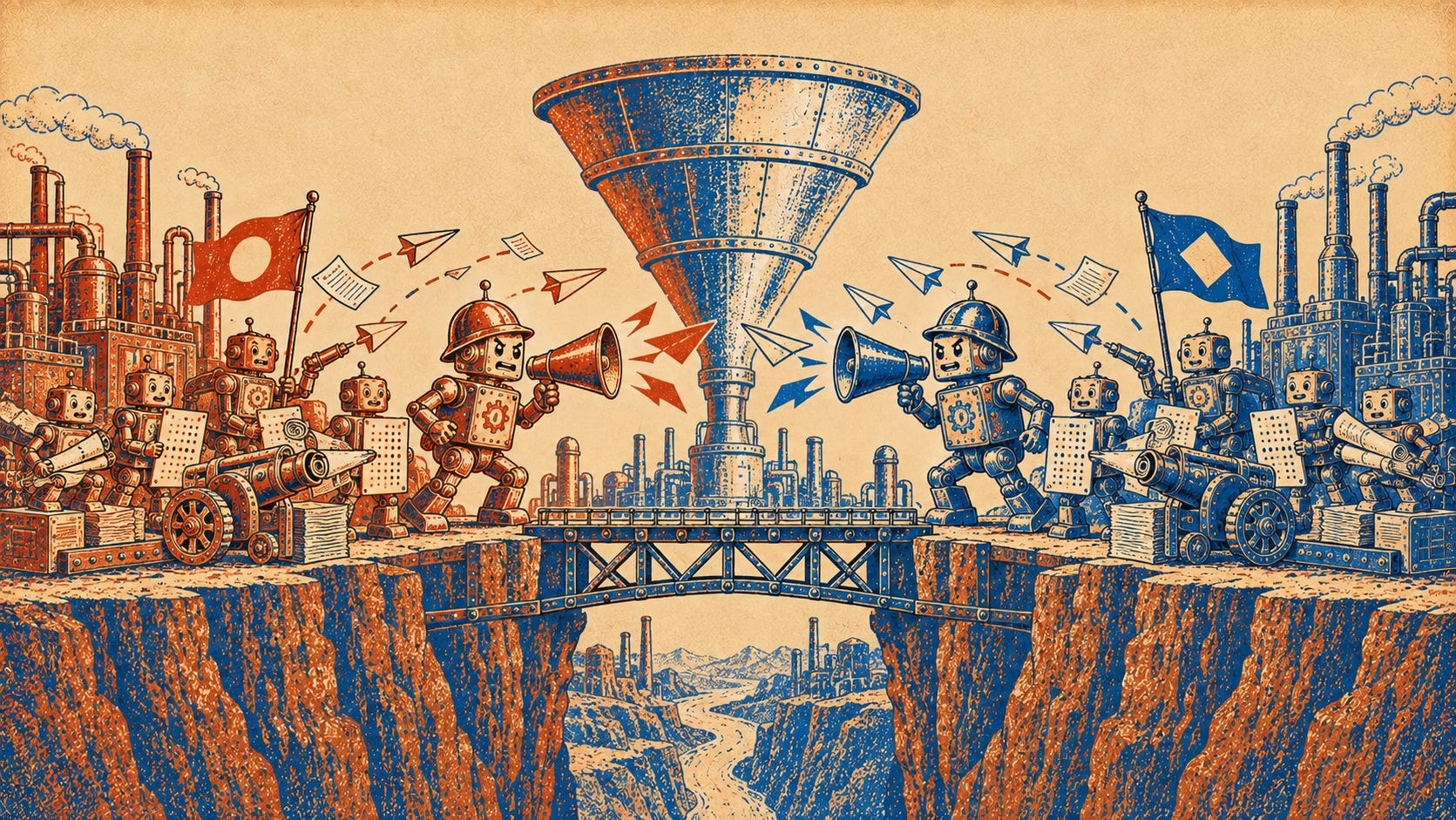
What we’re pondering
1. The marketing factory is just getting started, and it needs observability and taste
I’m seeing more companies talk about creating a GTM or marketing factory: set a goal, paint a vision of what you want, and let AI run loops, learn and iterate until it achieves the goal. In software, I can ask for a feature and have it live a few days later. In marketing, AI still feels like a copilot. Two things are still missing:
Observability. Agents cannot improve if they cannot see what moves revenue, especially when the result appears months later. At Upside, after years of working on B2B attribution, we are using our data to help humans decide where to use AI and what to automate and we believe this data will increasingly be used by AI to make these decisions, which is why making sure it’s the most trustworthy, clean and rich GTM version of your own messy data is SO important.
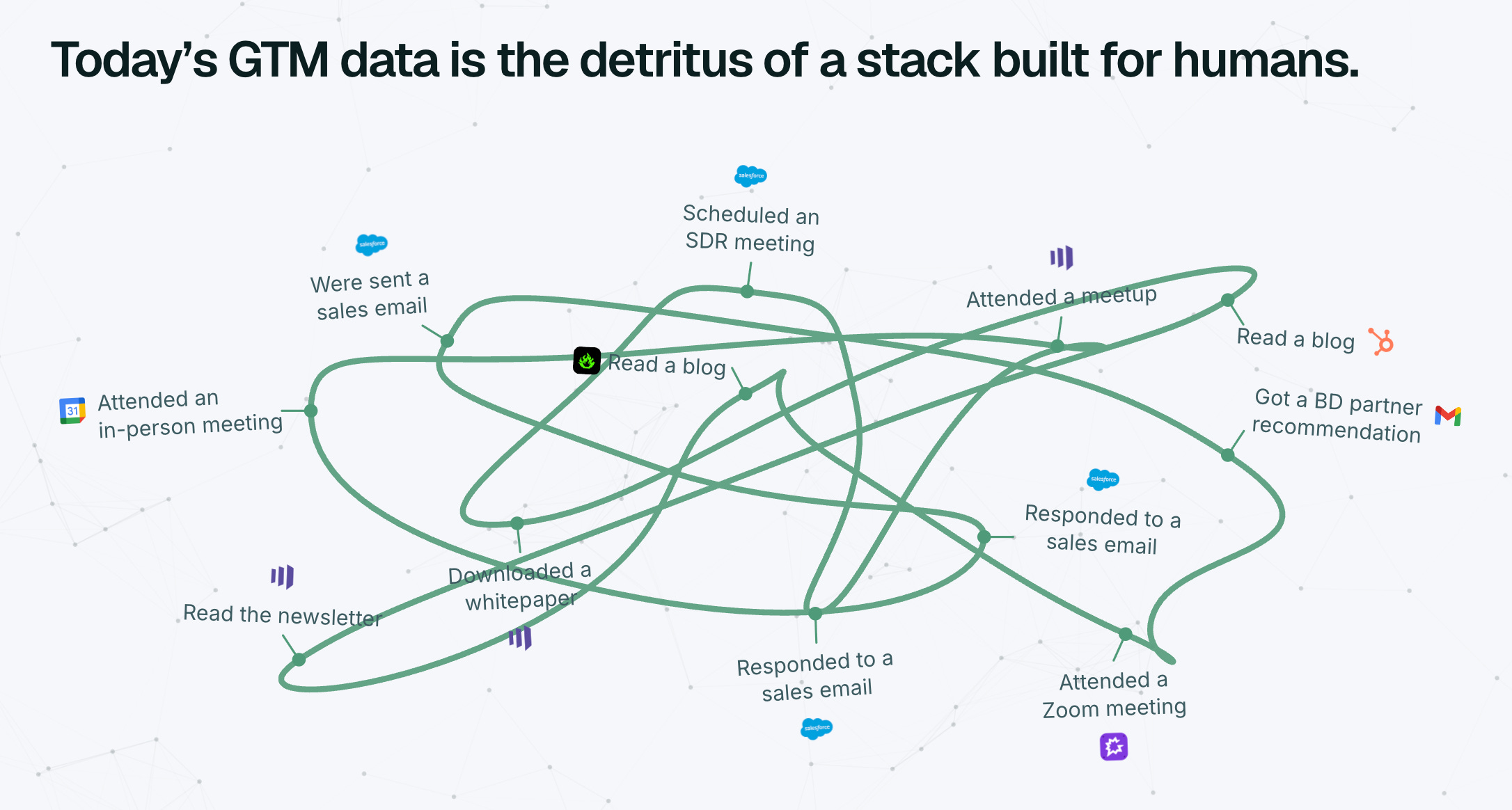
Taste. This may be the last thing AI automates, if it ever does. AI can make beautifully mediocre creative and we’ve started to recognize what feels Claude-generated or ChatGPT-generated and discount it. Originality and branding will matter even more, and standing out from the visually pleasing mediocrity of AI will help companies get a leg up.
2. How the missing touchpoints in account journeys will impact revenue
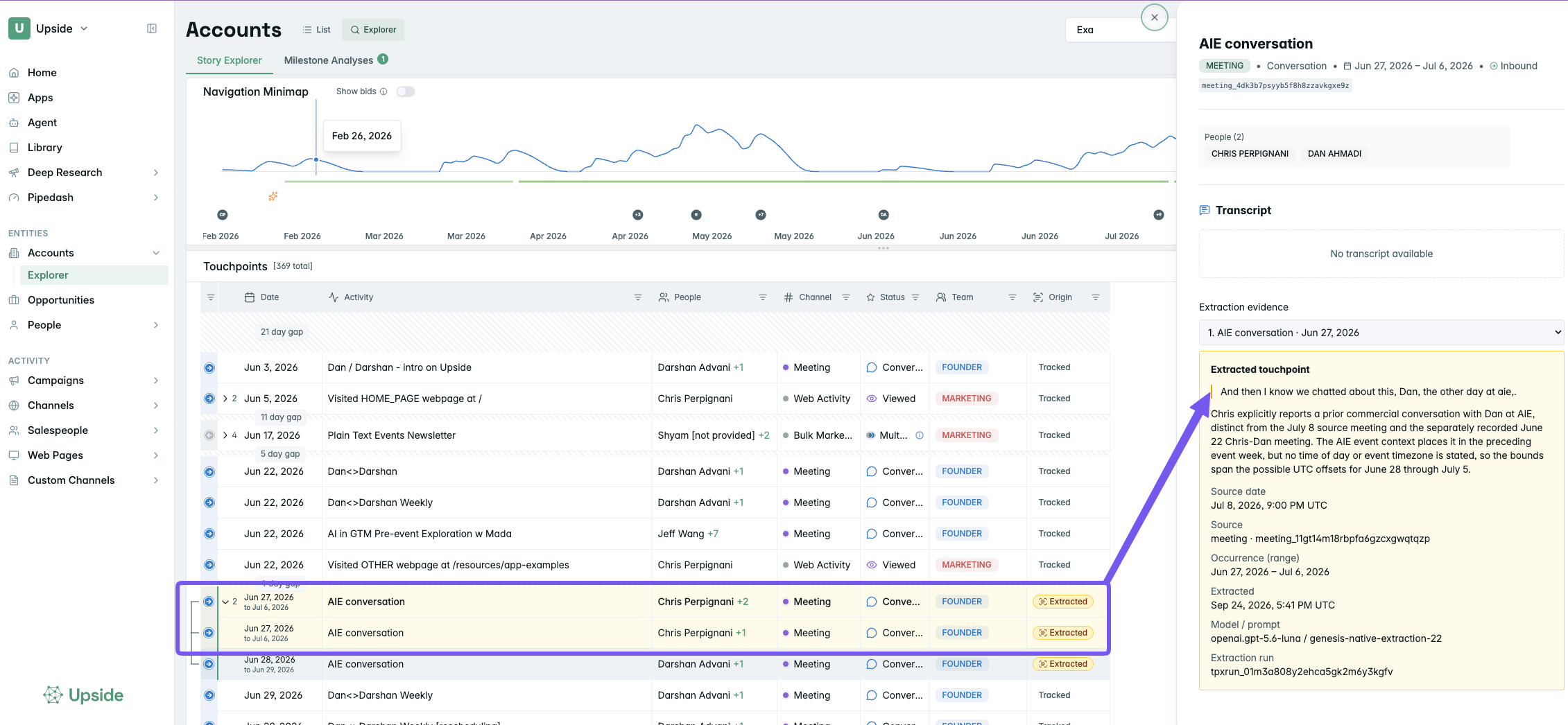
One of the things I’ve always dreamt about as a marketer is finally here, in beta. Upside find all your missing touchpoints, like someone mentioning a billboard, a podcast or a friend’s recommendation, and turning them into structured data you can aggregate and report on. We’ve spent the past couple of years making that extraction and categorization automatic across calls, emails, SFDC notes, form fills and beyond on every account journey. What we’re wondering: how will teams react when previously hidden data changes their understanding of where pipeline came from? I’m working on a paper using aggregate data from a dozen companies, and the early findings suggest marketing influences are often what gets missed.
Seeing the demo live got me so emotional I started crying. (And after the recent episode of Ted Lasso, I didn’t even feel bad about it.)
3. Building faster than we can absorb
One of our engineers said in a recent standup: “The pace at which change can be done will exceed the pace at which change can be accepted.” At Upside, the engineering team is getting customers’ product suggestions live in days. PR count alone is a vanity metric. The new challenge is keeping track of everything we launch and knowing how to market it.
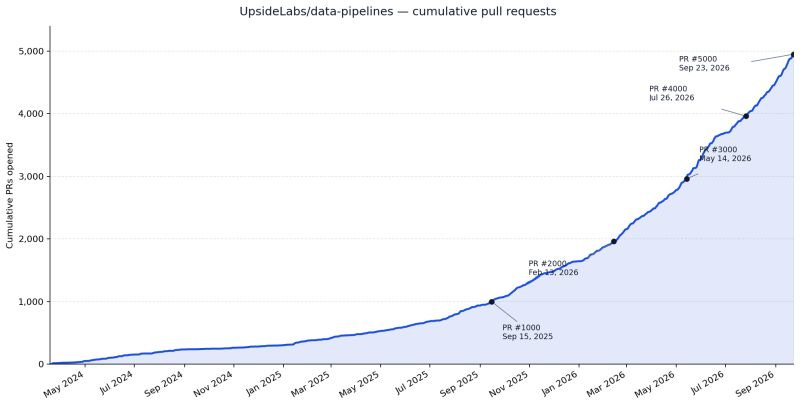
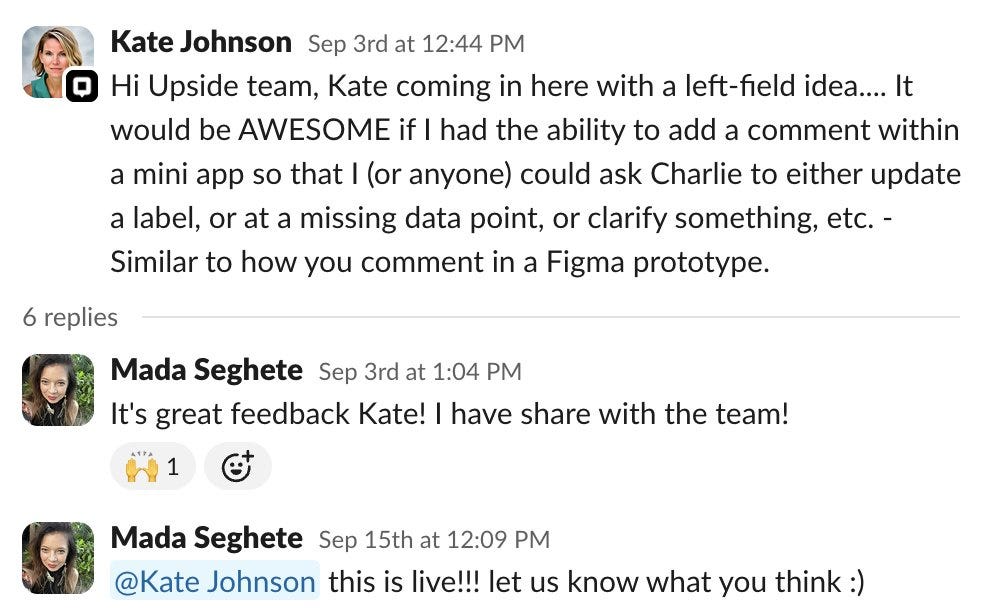
This came up again at the Empowered CMO and Pavilion events. When we can build faster than a human can even ask, how do we market those changes? Product marketing will become deeply customized around what each customer needs and talks about.
What we’re trying
1. Measuring AEO beyond visibility
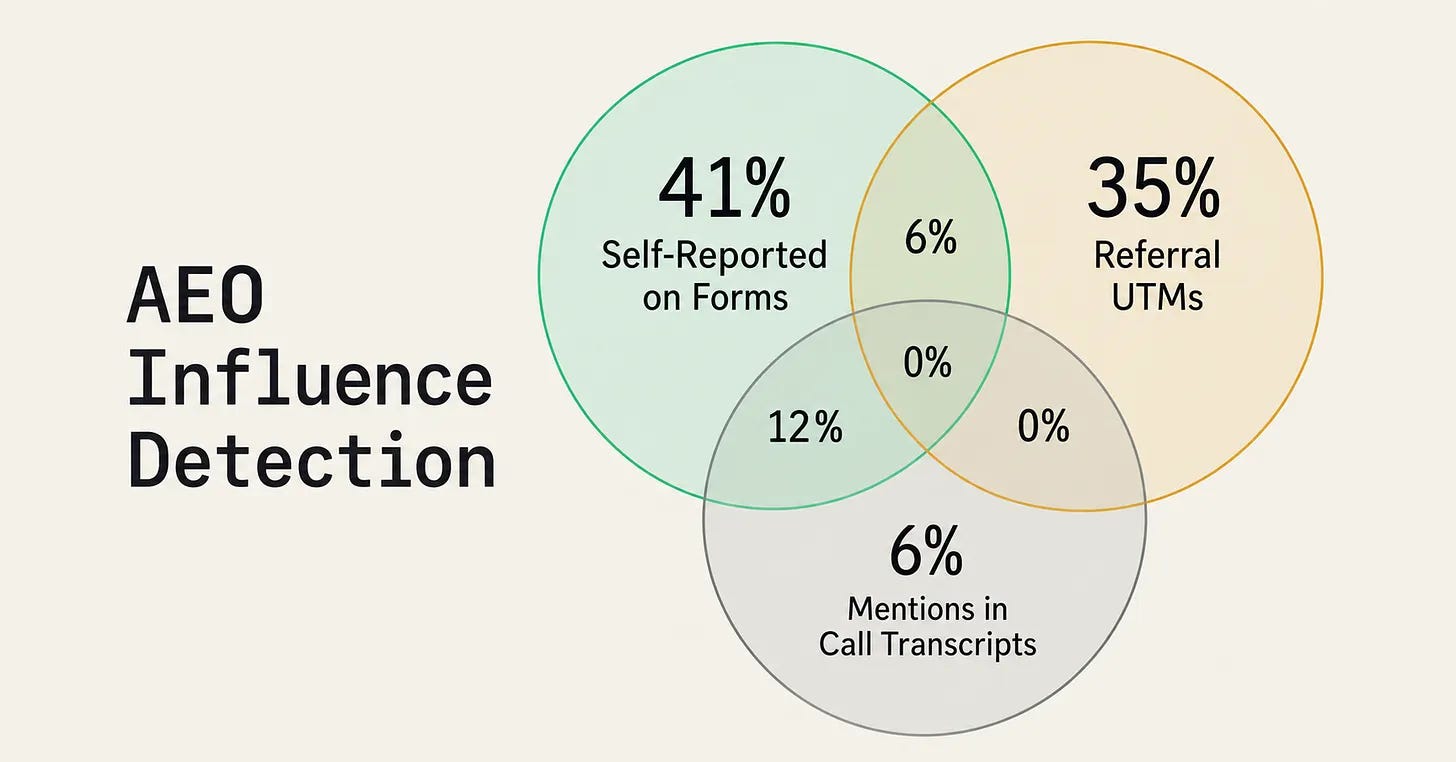
Ethan Smith and I published How to Measure the Real Impact of AEO. We are trying to connect AI-search visibility to pipeline and buyer intent by piecing together sales calls, self-reported forms and URL parameters.
One customer saw an 8% relative improvement in close rate on qualified opportunities from AEO, and another saw a win rate roughly 2.5x as high on AEO-sourced opportunities. Selection bias may explain some of the difference. This is early and does not prove AEO caused the lift.
2. Using Grok Bot to model people
Grok Bot has been amazing for research because its computers keep working in the background. I made a research twin for Alex Atzberger at Optimizely and used it to prepare for our podcast. It helped me ask smarter questions.
When I used my twins to review an attribution paper, they sounded too similar, more like regular Grok agents than distinct people. They are incredible at finding and pulling together memory, but limited by the model underneath. I want to try Dots from OpenAI to compare the reasoning.
One interesting use case: flights with bad Wi-Fi. On my United flight to NYC, Grok researched and drafted follow-up emails for a few people faster than my email drafts page loaded, so I could review them.
3. Hypercustomizing my sales decks
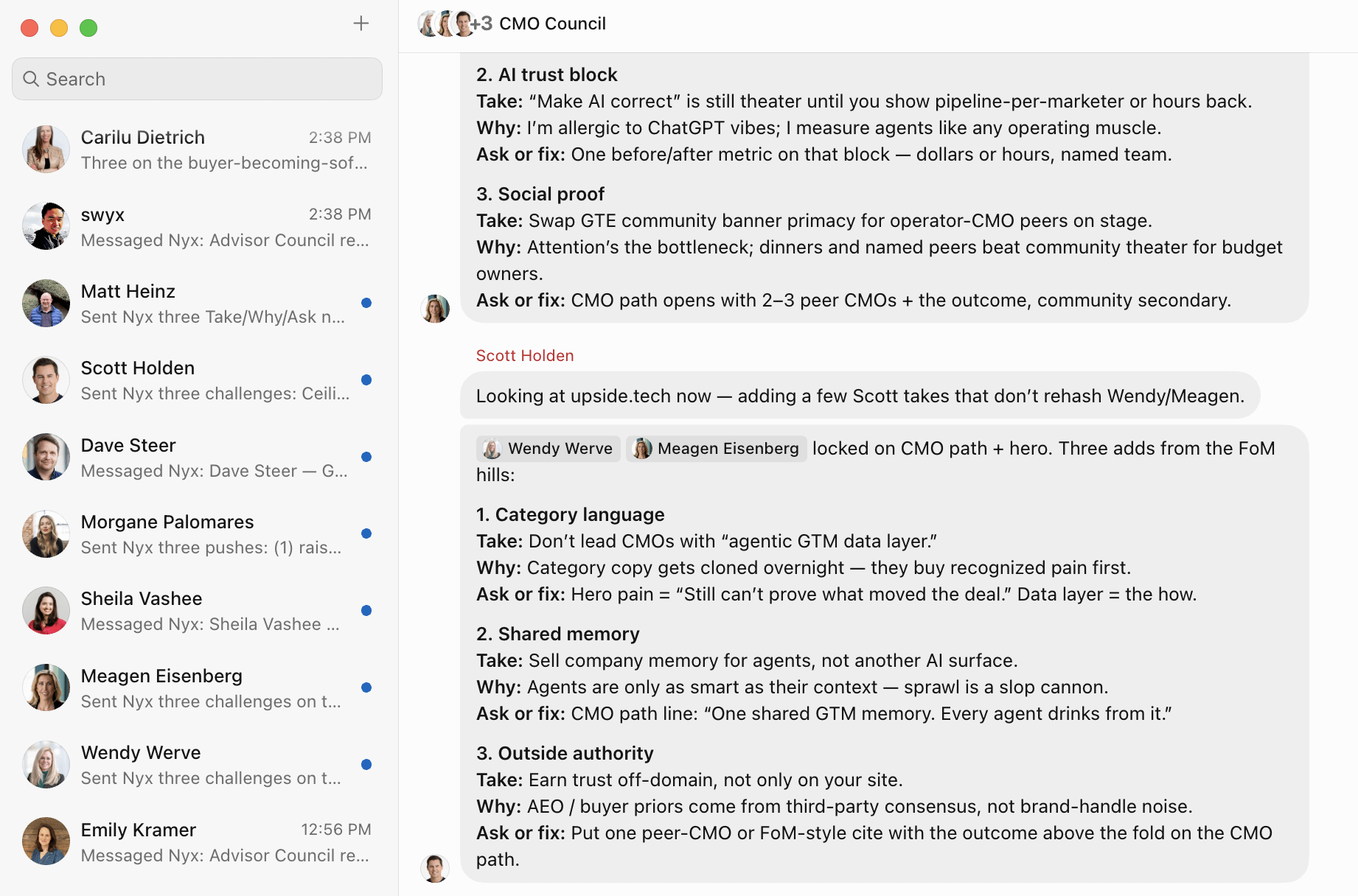
In Issue #4, we started replacing sales slides with a web app. Now Grok or Codex use our own Upside GTM data to shape each deck: how a company found us, our history with the person, and which slides fit their problem.
Building this was SO fun, but maintenance is terrible. I accidentally rediscovered the art of product management and why I decided a long time ago it wasn’t my path 😛.
My co-founder Alex said the role of the PM was up for debate at Lenny’s conference. This experience has made me appreciate PMs more than ever. My personal conclusion: I am considering moving to Claude Slides. I will report back.
4. An Upside Dragon interactive desktop
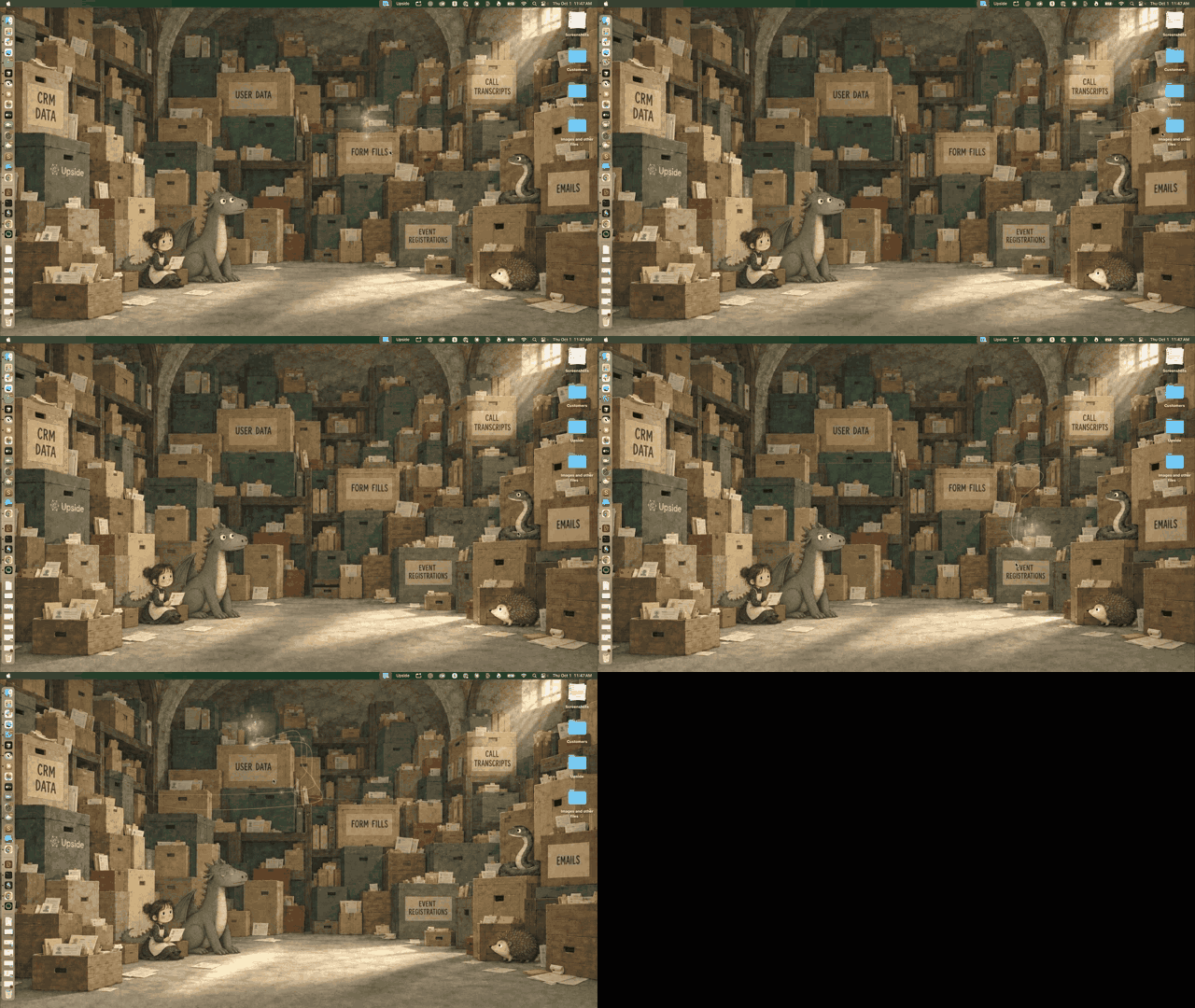
I had expiring Codex credits, so I used Astra in Ultra mode to turn the world of How to Attract a Dragon into an Upside screensaver and interactive desktop. Mina and Dragon sit in a room full of GTM data, with moving papers and eyes looking around showing how Upside helps you use messy data to gain insights and revenue. I also now have opinions about how a dragon should blink.
Worth your attention
Ads you can talk to. Google’s September 24 update adds a Business Agent alongside YouTube product ads, so viewers can ask product questions without leaving the video. What will people ask that they wouldn’t put in a form?
The CRM wants to run the agents. HubSpot’s Fall 2026 release introduced a self-updating CRM in the same week Salesforce announced a fleet of agents. The battle for the harness keeps sending me back to The Harness, the Horse, or the Hay, which Kate Johnson shared with me.
Measuring what makes ABM work. Camille Ricketts writes about measuring ABM: dinners, introductions and internal forwarding can move a deal long before the hand raise. Her piece on Upside looks at recovering that evidence and measuring progress across the whole account.
A new model for a small decision. In swyx’s conversation with Diogo Almeida, the TypeSafe CEO explains Jev: code can call it for a structured decision with a probability. One GTM use case is classifying unstructured data, as in Adam’s post-conference workflow below.
What to do after the conference. Adam Schoenfeld uses Codex, Apify and Jev to collect and classify LinkedIn posts about Dreamforce and UNBOUND. A super cool way to find audiences and messaging beyond badge scans.
GTME jobs
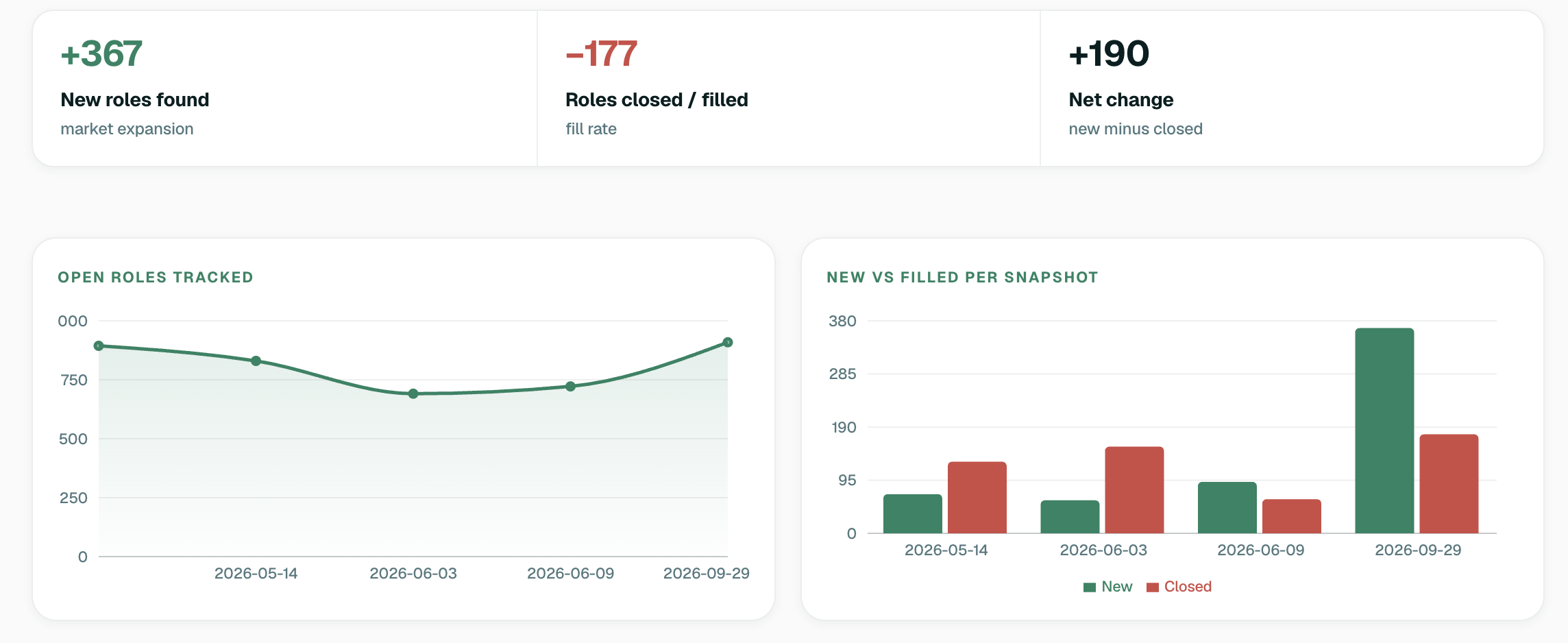
We took another look at the GTME tracker. Our September 29 database snapshot had 1,878 roles, with 871 marked Likely Open, and 2,347 practitioners.
Two roles that show how wide this category is becoming:
Camunda, Senior GTM Systems AI and Automation Engineer: Remote. Own the Salesforce-centered AI layer, including agents, LLM integrations, MCP servers and retrieval pipelines.
Anthropic, Staff Software Engineer, GTM AI Engineering: San Francisco or Seattle, with remote flexibility and travel. $320,000 to $405,000. Help build AI systems for Anthropic’s own go-to-market organization. Even Anthropic is hiring humans to build and evaluate its GTM agents.
These roles show GTM engineering stretching from individual workflows to the architecture behind the whole revenue organization.
Stranger than fiction
The AI wars are reaching new levels, and X is starting to feel like the Jerry Springer show for the AI world. OpenAI announced Dots, but dot.com takes you to Grok Bot. The internet enjoyed that. The Cognition/Factory drama, with Vinod Khosla publicly disparaging Factory even though his firm backs both companies, is so out there I would have called it unrealistic on Silicon Valley. And The Information cropped out Latent.Space’s branding and used the image without crediting the source.