

Hi, it’s Mada. Week four.
For the past week, I have been thinking a lot about self-improving AI loops. These have become common in engineering and are the basic building block for letting AI automate more and more complex work.
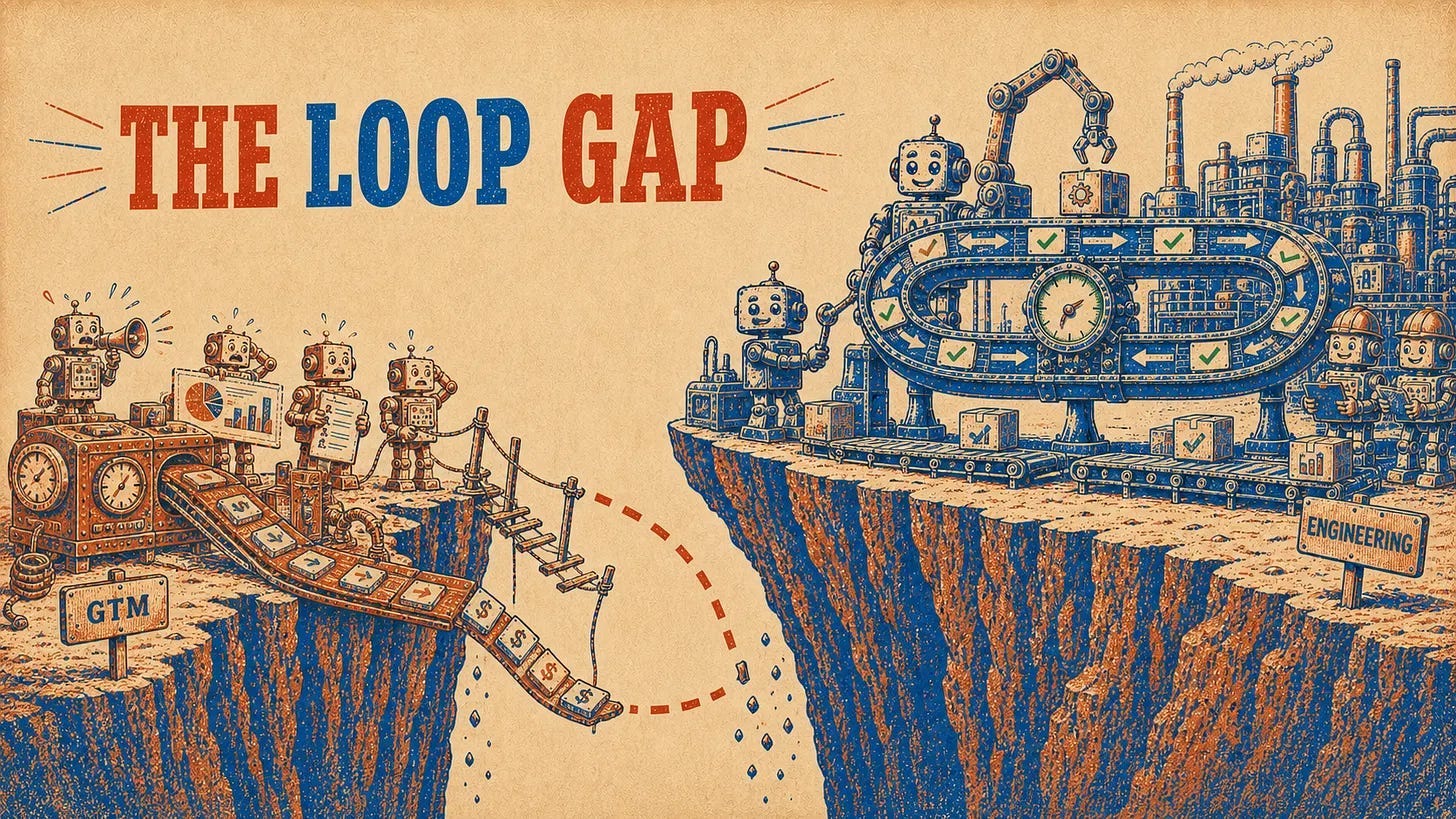
In the meantime, GTM feels like engineering 18 months ago. We’re automating a lot of work, but we have closed almost none of the loops and none of our automations are self-improving. Dan Ahmadi’s Google Ads agent is the closest example we have at Upside. Every day it looks at ads and results from the Upside MCP, adds negative keywords, and experiments with bids, copy, and landing pages without any of us touching it. But even that loop learns from clicks and demo requests, not which ad produced revenue months later.
And I am convinced data is what will bridge this divide. A self-improving GTM loop needs revenue to come back and correct what it learned earlier. The challenge is that, unlike in engineering, GTM loops take days, months, and even years to close. Figuring out how to do it will unlock a market 100x bigger than dev tools today.
The week in one minute
What we’re pondering: self-improving GTM loops, what is graph engineering really?
What we’re trying: Sales without slides, Codex as CoS, and live mini-apps as product specs.
Worth your attention: Clay Ads, Airtable acquisition, 3 pieces on loops, new GTME roles.
Stranger than fiction: OpenAI Summer Club, Karp’s SV monologues, tattoos for interviews.
What we’re pondering
1. How can we enable self-improving GTM loops?
A coding agent knows in seconds if a test failed. But a GTM agent sending an email gets a reply in days, pipeline in weeks, and revenue months after that. If you train it on the fastest signal, it learns to chase the fastest replies. Those might not be the best replies for driving revenue. Just like humans, agents need to use fast signals for short-term improvements, as well as long-horizon signals for more significant, meaningful improvements. What we’re starting to test is whether the same data humans use to create pipeline sourcing dashboards and attribution reports IS the data agents can use to self-improve. They just need a hierarchy and guidance on what data to use when.
2. Agent org design.
Graph engineering is all over Twitter, so even though I’m not an engineer, I started watching the videos. It seems to me it’s just another term for complex agent coordination: who acts, who judges, when the system branches, and who can stop it. Basically, org design for agents, which is how many complex agent systems are built today. I recently wrote a more technical deep dive into how my co-founder Alex built Pipedash, our attribution product that runs on Upside data, but anyone can copy the pattern. Pipedash uses the same pattern.
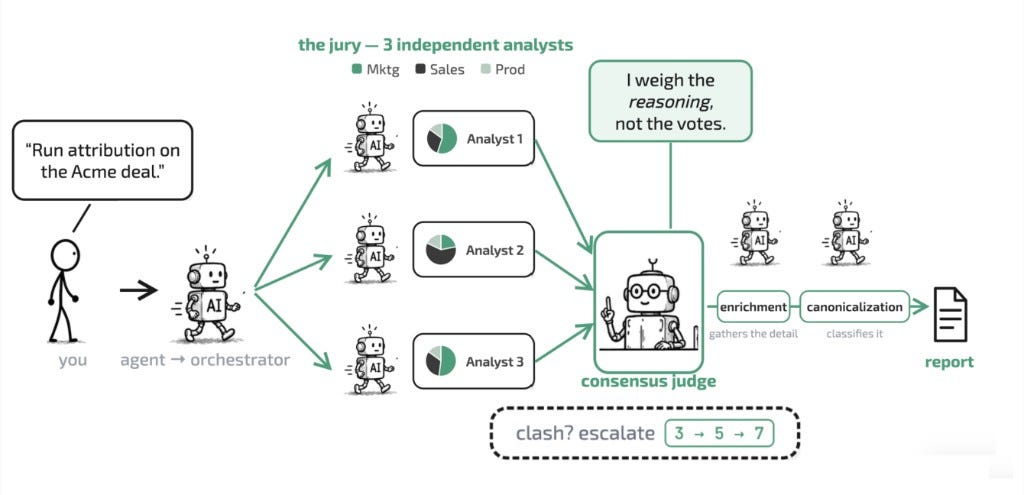
One agent sets up the work, three analysts make independent attribution calls, then a judge compares their reasoning. Disagreement means adding more analysts to give their opinions. Two evidence and taxonomy agents do additional checks and can veto the final answer. This way, no one agent gets to research, decide, and approve their own work.
What we’re trying
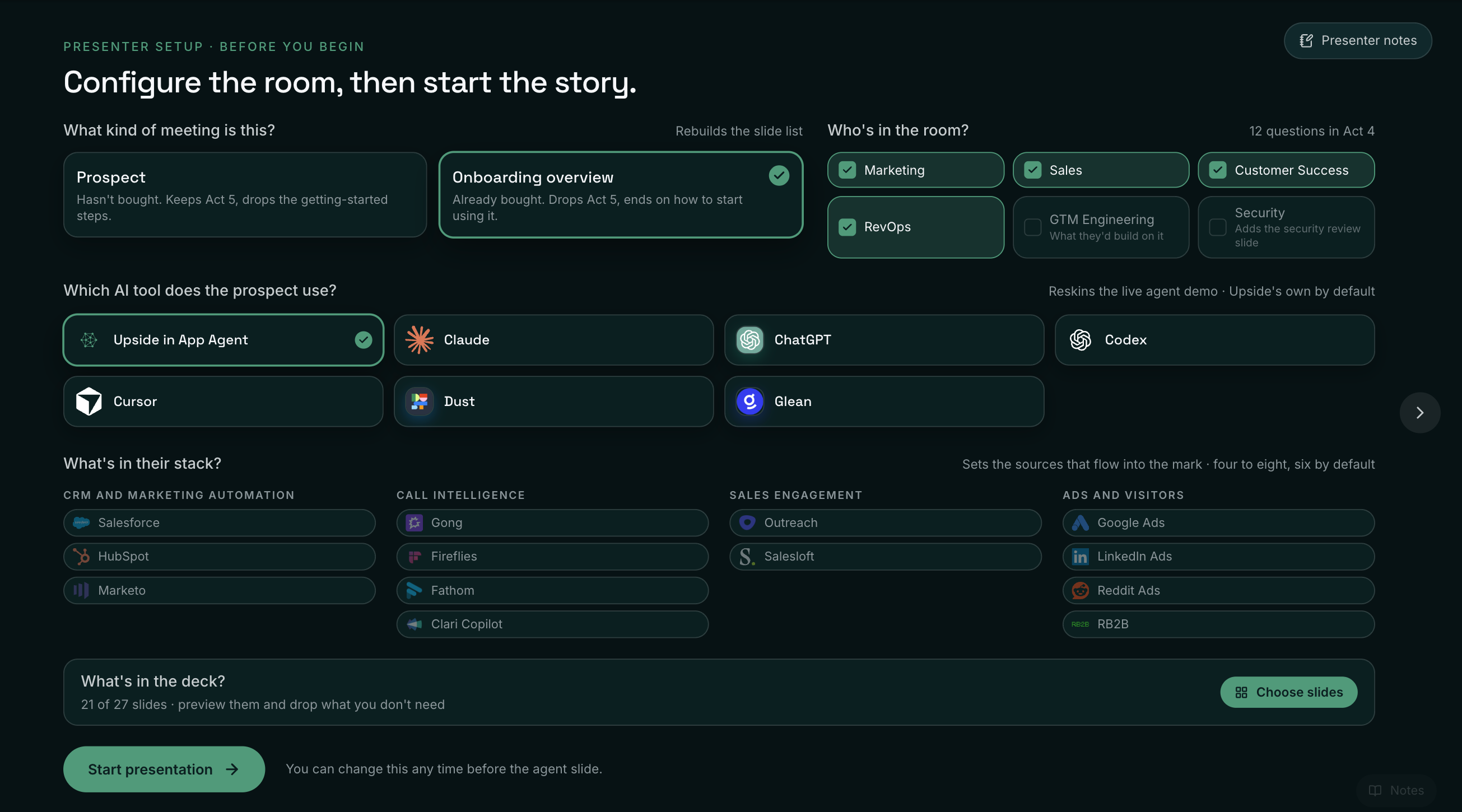
No more slides? One ritual we kept from HF0 is our version of weekly demo nights. Over time, all the slides turned into HTML panels, so our intern Avni and I wondered: why not build our actual sales pitch the same way? Before (or even during) a meeting, we can do discovery on a prospect’s AI tools, GTM stack, and priorities, and the presentation gets customized for their org. I made a public version you can try yourself here.
Moving my chief of staff into Codex. I recently stole the Codex Micro from swyx and decided to try to move my chief of staff from Cursor into Codex so I could use it. The challenge was porting context, so I ended up building my own memory in Obsidian. I will show it alongside my Codex Micro setup at Codex for Marketers in San Francisco on August 13, organized by the amazing Angela Ferrante (who actually pushed me to try Codex more seriously).

Mini-apps instead of specs. Avni and I have also been redesigning our dashboard homepage, and instead of writing specs or wireframes, we found ourselves just building the prototype and handing it to engineering as a standalone working version with live data and all the queries tested and working for our Upside instance. I wonder what this means for how products will be built. Engineers are still needed, but will users be able to edit and configure their own version of any piece of software?
Worth your attention
Clay made Ads available on its Growth and Enterprise plans on August 4. It turns CRM fields, sales activity, and buying signals into self-updating audiences synced to ad platforms. Clay claims match rates of up to 95 percent on LinkedIn and 90 percent on Google. This is not new. We have been seeing it in consumer for a long time, so I am surprised to see so much buzz around this launch.
Bending Spoons agreed to buy Airtable at a $1.285 billion enterprise value. Equity value is about $2.25 billion because Airtable has cash, so the viral “$11 billion to $1.3 billion” comparison is not apples to apples. Still painful after raising roughly $1.35 billion and reaching an $11 billion pre-money valuation in 2021. Less talked about is that Airtable CEO Howie Liu moved Hyperagent’s assets and liabilities into a new company outside the deal. I assume he will continue to operate it, and I’m curious which employees move with him.
Three useful reads on loops:
Kamila Selig found only two of nine production loops she studied were actually improving.
Jeff Ignacio explains where looping agents fit in GTM, including the difference between improving within one run and improving across runs.
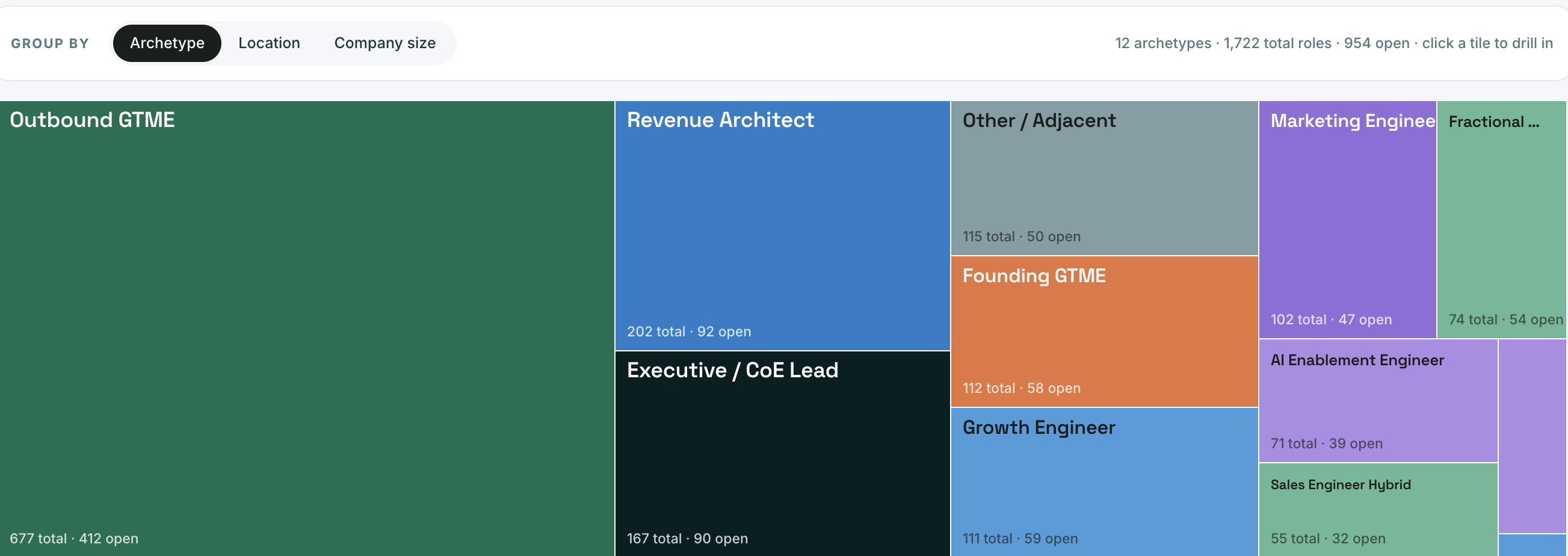
The GTME tracker has 1,722 roles, 953 that look open, and 100 added since July 28, more than double the prior week. Source batches can distort one week, so the mix matters more: 15 Growth Engineer and 11 internal FDE roles arrived, versus two and zero the week before.
Immuta, GTM Platform Engineer: $115k to $140k
OpenAI, Applied AI Engineer, GTM Growth Engineering: $230k to $385k plus equity.
Databricks, AI Engineer, GTM Analytics: $146k to $201k.
Head of Ads, Enterprise Marketing for OpenAI: $374k to $415k. This is not really a GTME role and was not found by my database, but I got targeted on LinkedIn with it and it looks like a cool opportunity.
Stranger than fiction
OpenAI sent influencers to Summer Club. OpenAI took a group of influencers to a luxury retreat with beekeeping, painting, and classes on ChatGPT Work. The posts were... interesting. My favorite begs people to get off Instagram and start posting on LinkedIn to get expensive trips paid for by big corporations. Not sure whether to be scared or excited about what’s coming to my LinkedIn feed next.
Alex Karp turned an earnings call into a Silicon Valley monologue. Palantir’s second-quarter revenue grew at 93 percent year over year, but somehow Karp celebrated by calling frontier AI labs Marxist, accusing them of trying to colonize the enterprise (I can see this one in my head), and still worked in people who eat vegetables.
LemonLime offered instant interviews for tattoos. YC keeps growing as a status symbol. Seven people got inked at a YC Startup School afterparty! The founder apologized, offered to pay for removals, and then disputed whether anyone got the company logo. The prize was still only an interview. The founder later claimed everyone got one whether or not they got inked.
If you have built a GTM loop that learns from revenue, even a tiny one, hit reply. I want to see it.
Mada