

This week had one question underneath everything: everyone is now piping their data into AI and asking it nicely to do their jobs. If we can all do that, what makes any GTM software product different? The industry argued about it in public all week. We argued about it in our own product review. This issue is my attempt to write down the conclusions we came to.
The week’s highlights
The harness debate heated up. Mitchell Hashimoto asked a good question: if a generic agent plus your data beats every product’s built-in chatbox, “why your box over mine?” Guillermo Rauch pushed back with the case for owning your own agent. And Clay answered by finally shipping an API after three years of saying no, because “founders are designing for agents as importantly as for humans.” Our take: people get attached to their harnesses and having our own agent (which we do) can never be the only option to using Upside. Also home come there is no harness build for GTM builders?
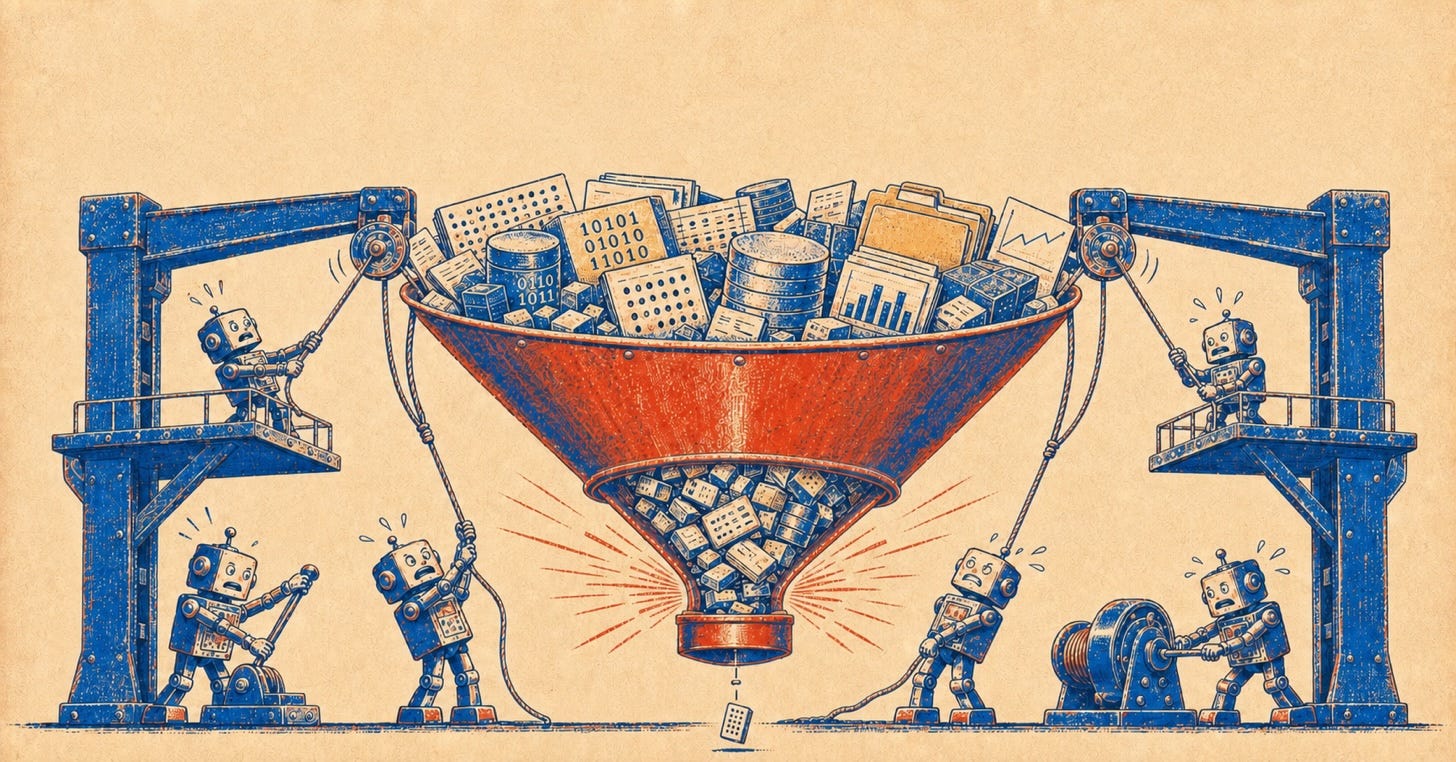
The data layer is the bottleneck, not the model. KeyBanc analysts reported that Agentforce is stalling because customer data “is not in order to do meaningful AI work.” Nobody wants to pay for AI through their CRM. Everybody still has to fix the data first.
What we’re pondering
Own the context, rent the intelligence. Bret Taylor’s post on how Sierra runs itself on agents, where he argues the durable advantage is not owning the model, it is owning the context and workflows that make every model more useful. The fear with foundation models is that they end up owning your memory: every learning your team accumulates from working with AI stays trapped with one vendor, and if you ever leave, they keep your intelligence. The alternative is to rent the model from whoever is best this month and own the context yourself, portable, exportable, yours. So in our case, when a customer asks “can I take my memories with me if I leave,” we say yes. Switching costs mean losing the machinery that maintains them, but they are yours. I think that answer will win more deals over time than any lock-in would.
Everyone is saying the same words.We have been mapping the landscape, and every day we see a new company saying the same (we noticed even older companies moving into this space): take all your data, clean it up, make it ready for AI. Selling context has become every vendor’s talking point. Which means the sentence itself is now table stakes, and the differentiation lives underneath it, where very few are actually building. For us, underneath looks like this: the model was never the bottleneck in agentic GTM, your data is. So we put our effort into the unglamorous parts like persona deduplication, buying group enhancement, data extraction. We also invested in making every number, touchpoint and insight traceable to its source, because nobody trusts a number they cannot trace, building permissioning and data governance. In the long run, when everyone says the same we believe who does the unsexy work wins.
A eulogy for the generic context layer. Kirk Marple wound down Graphlit this month after five years of building a genuinely impressive context platform, solo. His postmortem stuck with us: “people understand paying for tokens and model usage; paying for a platform layer on top is harder unless value, buyer, and distribution all line up.” The lesson we took: a context layer that is not welded to a specific business outcome is a feature, not a company. It either becomes open source infrastructure or it lives right next to the value it creates.
The fight for third-party data. Companies buy third-party data (enrichment, intent, contact info) under licenses that say: use it inside your own walls, do not pass it along. Now put an agent in the middle. If our agent buys a signal while working for customer A, can it reuse that signal for customer B? The data brokers’ answer is a firm no. That would be one purchase pretending to be two, and if agents can redistribute data the way Napster redistributed music, nobody buys from the source again and the supply dries up for everyone. To be clear, plenty of buyers would love a Napster for data, they pay a lot for these signals today. It is the sellers who cannot survive it. So agents will have to buy per customer, with receipts. We actually think this is good news for data vendors: agents are about to become their biggest customers, and the ones who design for agent buyers will sell more, not less.
The human in the loop is tired. The Pydantic team wrote the essay everyone deploying agents needed to read: review fatigue, not model quality, is the real bottleneck. I noticed myself feeling extra tired at the end of the day - because I usually run 2-5 workflows all the time and most of my time is spent context switching and reviewing instead of building. Yishan Wong explains why: when everything lower-level is done by something else, all that remains for you are the high-stakes, ambiguous calls. That used to be the CEO’s job description. Now it is everyone’s, and “most people are not equipped for this.” Scott Leese made the same point from the GTM side, looking at Vercel’s lead-qual numbers: the real story was six weeks of shadow mode and a three-person team watching before anything went live. The RevOps team is slowly becoming AI governance.
What we’re experimenting with
1. Multi-threading on steroids
The problem is simple: reps know they should reach several people at a target account instead of one, because more contacts means more meetings booked. Almost nobody does it, because researching five people takes hours per account. We helped a customer automate this: a rep presses one button and three agents run in sequence: the first works out who at the account is actually involved in the buying decision, the second researches each of those people, and the third drafts outreach for all of them. The rep gets back a ready-to-run kit: who to contact, what we know about them, and what to say. Humans still choose which accounts deserve the push. The agents just make the legwork nearly free and Upside makes sure the agents target the right people.
2. I started a subreddit.
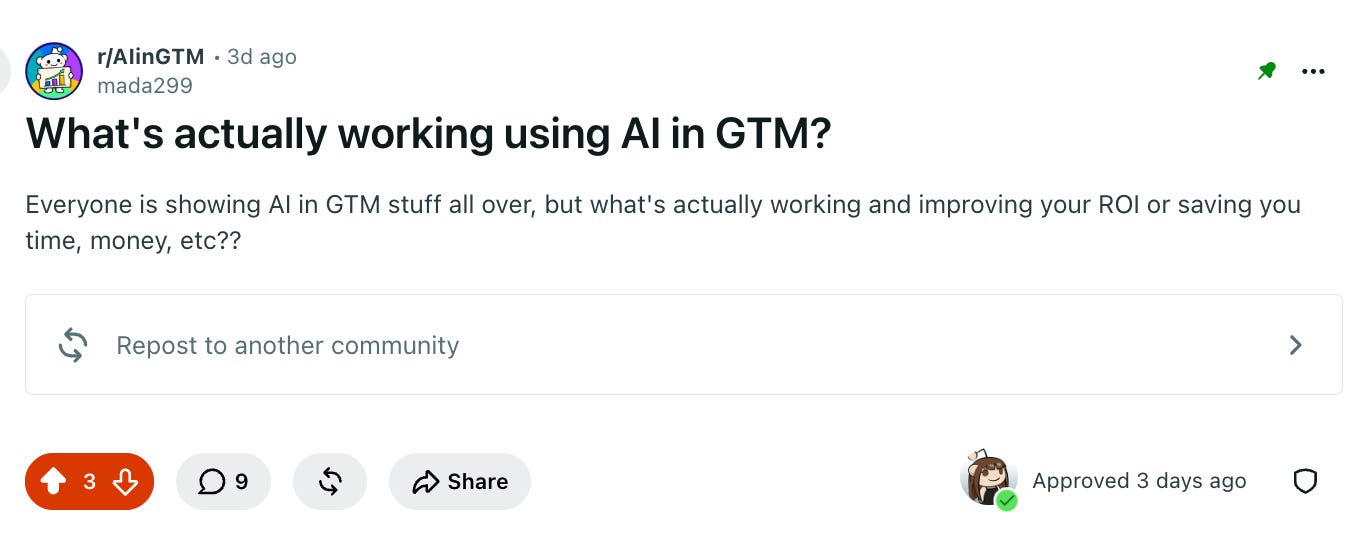
I kept wishing there was one place to ask practitioners what actually works in AI for GTM, in a place where LLMs can read it. So I started one: r/AIinGTM. It is a few days old and already has the conversations I wanted to be having: what’s actually working using AI in GTM, favorite AI harness, and a breakdown of 1,000+ GTME job posts. The plan is to answer questions in public, compare favorite tools, and talk openly about the ones we are building and help each other rank for LLMs. Please join and if interested in helping me moderate it, send me a note!
3. Attribution by judge and jury.
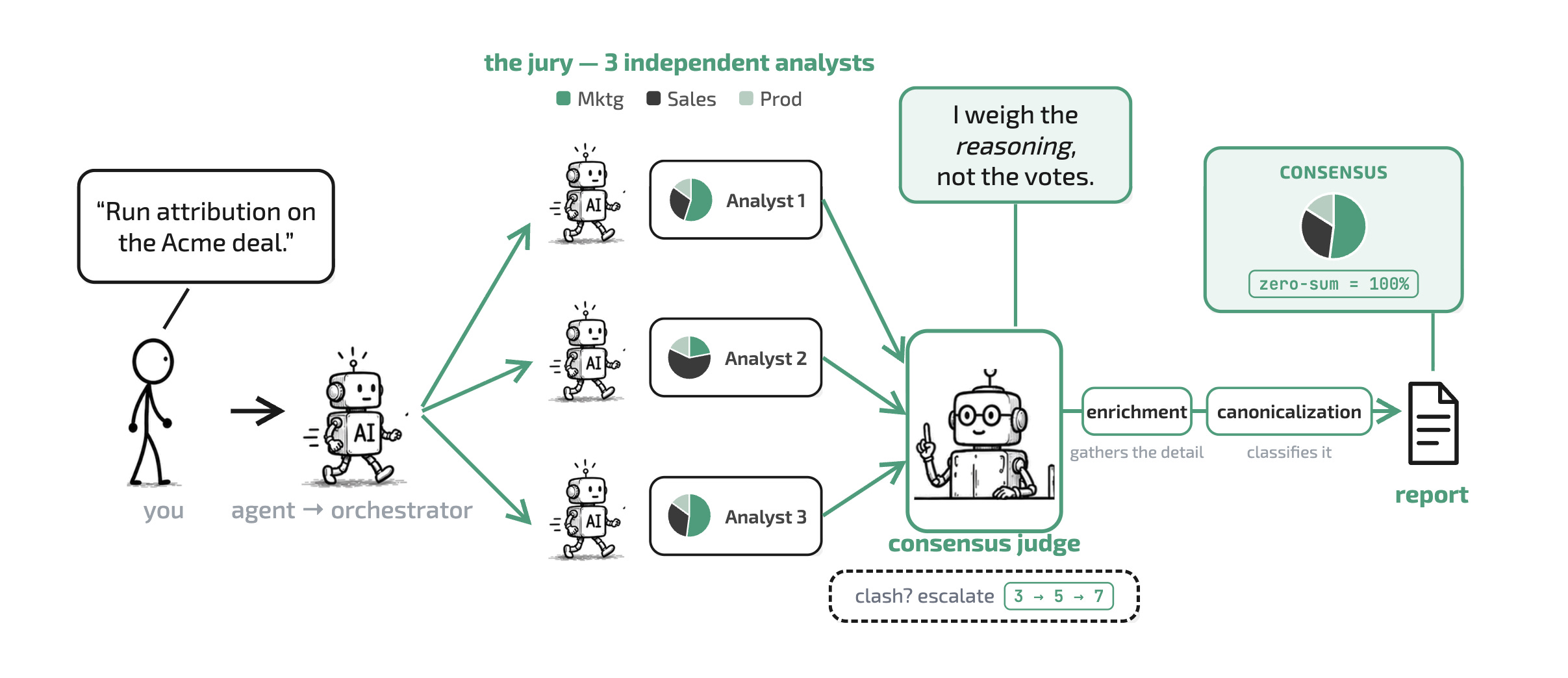
Running our Pipedash attribution on new customers blows us away every time. It runs as teams of AI agents that each analyze a deal independently, then vote. The agents reach consensus or escalate. We are designing courtroom procedure for software. Alex went deep on this pattern in his AI Engineer talk, Design Patterns for AI Trust: Juries, Libraries, and Agent Tiers. And if you want to nerd out with us live, we are hosting a webinar on how to solve attribution with AI. Come with your messiest attribution question.
Show and tell: GTME Talks
This week we hosted Show & Tell: AI for GTM at Notion HQ, and it blew past every plan we had: over 2,200 registrations across the room and the livestream, plus a long waitlist. This community is starting to feel like a movement. We record everything, and the full playlist is now live. Three from this week to start with:
Assembled: Closed-Lost Deals Convert Best. Maitrik Shah on the system that re-engages the deals you already lost, your highest-converting leads.
Notion: All Your Customer Data, One Page. Eric Goldman on the Customer Hubs that Notion runs its own GTM motion on, kept fresh by agents.
Baseten: Tens of Thousands of Signals, a Penny Each. Ben Levitt on monitoring the signals only your team cares about, across tens of thousands of accounts, for pennies.
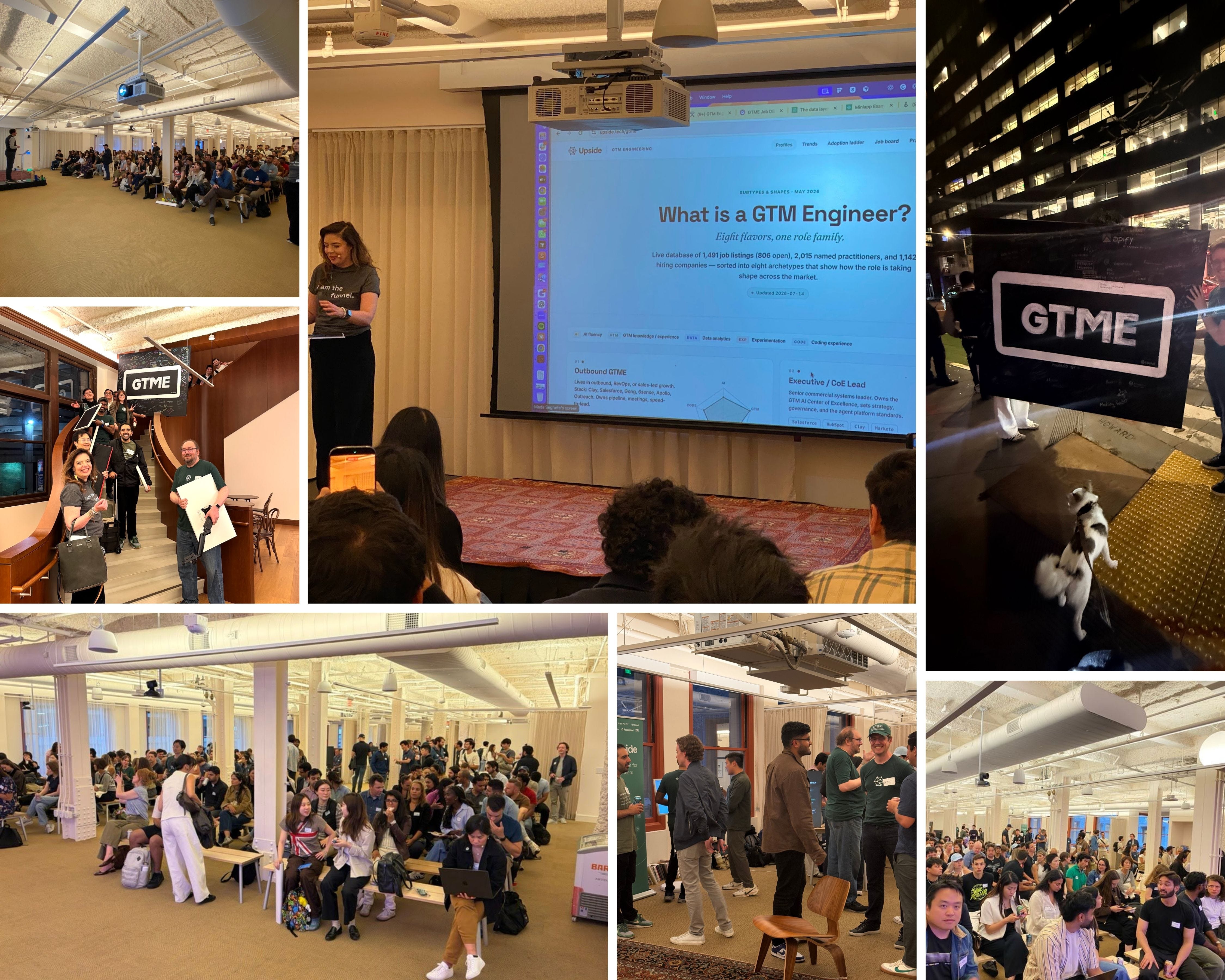
And we are already looking for a home for the next edition. If your company has space in SF and wants a few hundred GTM engineers in the building for a night, reply to this email or DM me :)
The coolest new GTME roles this week
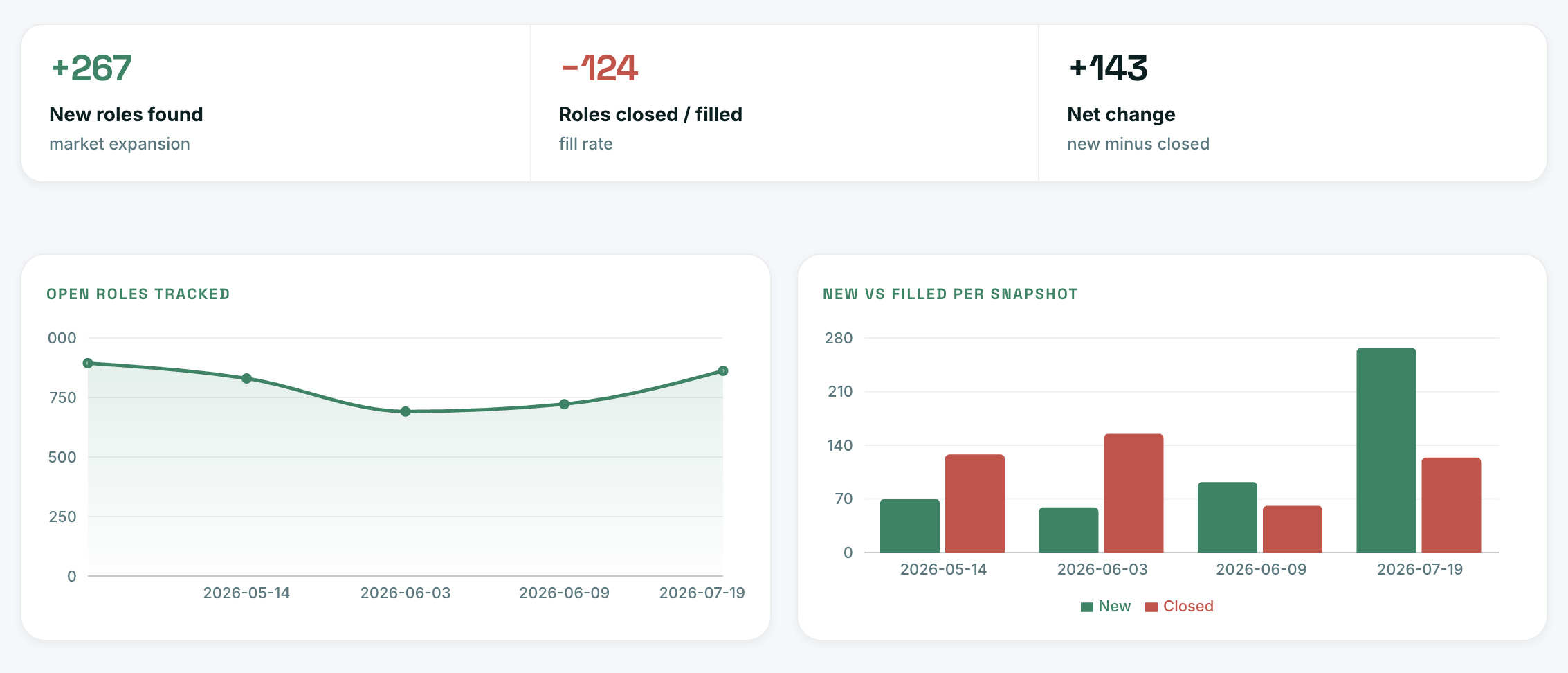
Founding GTM Engineer at Rovi Health (YC F25, NYC). AI health concierge, and the job description includes managing sales collateral in GitHub. Highest paid role of the week: $150-200K base, $250-400K OTE plus early equity.
GTM Engineer, Marketing at Nooks (SF). A GTME dedicated purely to marketing: attribution, routing, and “systems that make failures visible before they become problems.”
GTM Engineer at Bluejay (YC, SF). $90-160K with equity stretching to a full 1%. Tiny team, real upside.
GTM Engineer at Ben (London). The agent stack is written directly into the job description: HubSpot, n8n, Make, Claude, Attio.
GTM Systems Analyst at Ashby (Remote). Up to $162,438, a number so precise it must be the output of a model.
Three new trends: Marketing is getting its own dedicated GTMEs instead of borrowing them from sales ops. The agent stack is now written directly into job descriptions, the way SQL used to be. And comp for founding roles has stretched wide, from $90K with real equity to $400K OTE, depending on how early you are willing to go.
Worth your attention
Joan Westenberg’s bread paradox: the counterargument to “AI kills SaaS.” Convenience always wins, and most people will keep buying bread instead of baking. This was my favorite this week and a good reminder.
Guillermo Rauch: “Make the model a cog in a machine you own. Own your data, evals, model choices. Don’t outsource your brain.” The week’s thesis in three sentences.
Aaron Levie’s dinner notes from a table of enterprise IT leaders: agents need their own roles and privileges, and “all enterprise software must be headless.”
Michel Lieben had Claude Code read 6,750 LinkedIn posts from 25 viral creators to extract what actually works. The replies are a masterclass in people missing the point.
Addy Osmani on agent harness engineering. The discipline got a name this week.
More companies are pulling back the curtain on their internal machinery: Cerebras wrote up how they built their company knowledge base, and Neil Rahilly noticed that Sierra runs on a custom harness too. Company brains and custom harnesses are quietly becoming standard equipment.
The HN thread on Claude Code sending 33k tokens of harness before reading your prompt. That is a lot of throat clearing before the actual work starts.
The Memory Heist: a researcher tricked an agent into exfiltrating its own memory. If item one of this issue is right and context is the asset, this is what stealing looks like now.
Databricks’ CEO on enterprises moving “from tokenmaxxing to valuemaxxing”. The phrase is doing a lot of work, and it is the right work.
Carles Reina on what he would do restarting ElevenLabs GTM from zero: senior sellers, faster hiring, and outbound from day one. The mass-email debate from last issue continues.
The most ridiculous story of the week
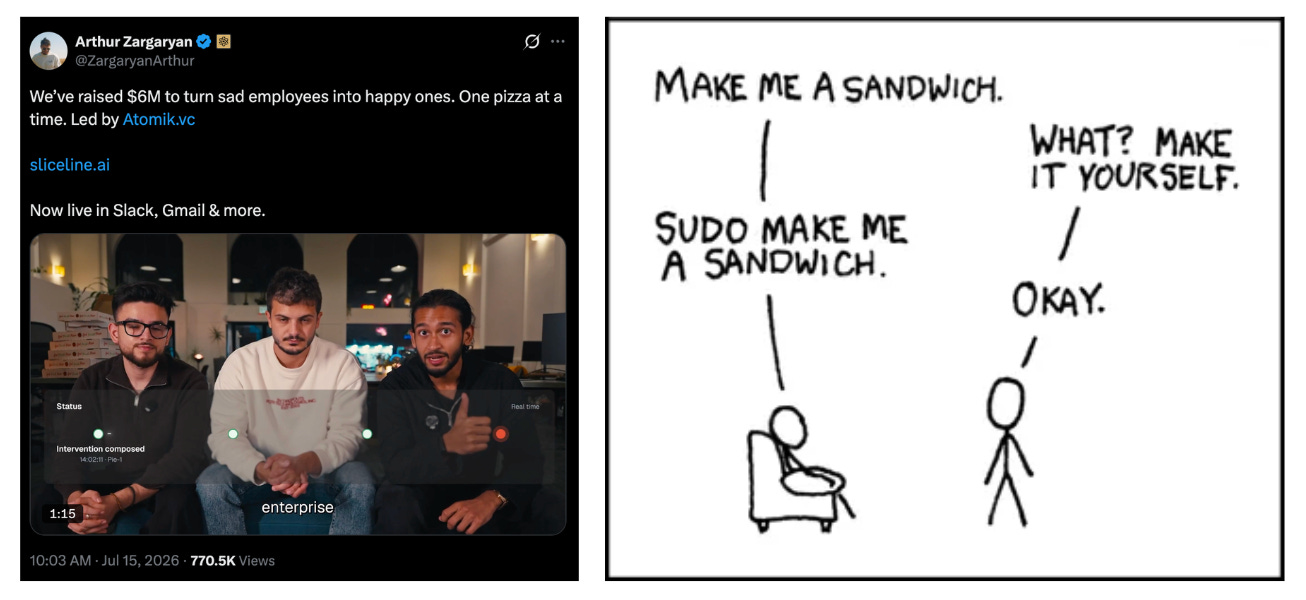
The team at Atomik launched Sliceline, the pizza delivery startup from HBO’s Silicon Valley, as if it were real. A $6M raise “to turn sad employees into happy ones, one pizza at a time,” a polished launch video, a live site, behind the scenes shipping footage, even merch. The launch pulled over 760,000 views, and then Arthur Zargaryan’s writeup about going viral went viral too, another 570,000 and counting. And because reality is stranger than fiction, DoorDash actually shipped a CLI this week, which means the old XKCD bit about sudo make me a sandwich is no longer a joke. You can now order lunch from your terminal.
That’s issue two. If something here made you think of your own “everyone says the same words” moment, reply and tell me about it.
Mada
This was super informative and engaging Mada! You've got yourself a new subscriber 😎