

I have spent two decades in attribution and I have developed a love/hate relationship with it. I was replaced as Branch’s CMO (though as a founder it was more of a quiet transition) because I couldn’t credibly prove marketing drove revenue. I helped build Branch’s in-house attribution model, got my job back, and it helped us scale past $100M in revenue. So everything below comes from scar tissue.
B2B attribution was never solved because it was never a math problem. It was a memory problem.
Every model, first-touch, last-touch, W-shape, all the alphabet soup, was doing math on a record that was mostly missing. A fourteen-month enterprise deal with ten logged touchpoints isn’t a data set, it’s a rounding error with a dashboard. The referral over coffee, the exec who joined one email thread but wasn’t logging her emails, the podcast they listened to last month: none of it was ever tracked. Smart people looked at that and declared attribution dead: Matt Heinz wrote the category’s postmortem, Jeff Pedowitz called it “fool’s gold”, and Adam Ortman buried last-click in Forbes. They were right about the models. They gave up one step too early, at the data.
AI changed that. Not “upload your Salesforce export to ChatGPT” (please don’t), but AI applied forensically: reading every email, calendar invite, call transcript, and CRM record, and reconstructing what actually happened, including the buying group nobody logged and the referral mentioned once on a call. People tell you on calls why they came to your website, what they asked chatGPT about you - that data is just messy and unstructured, we use it all as a source of signal (not source of truth) to reconstruct the real story.
Once you know what happened, AI can solve attribution. We did it.
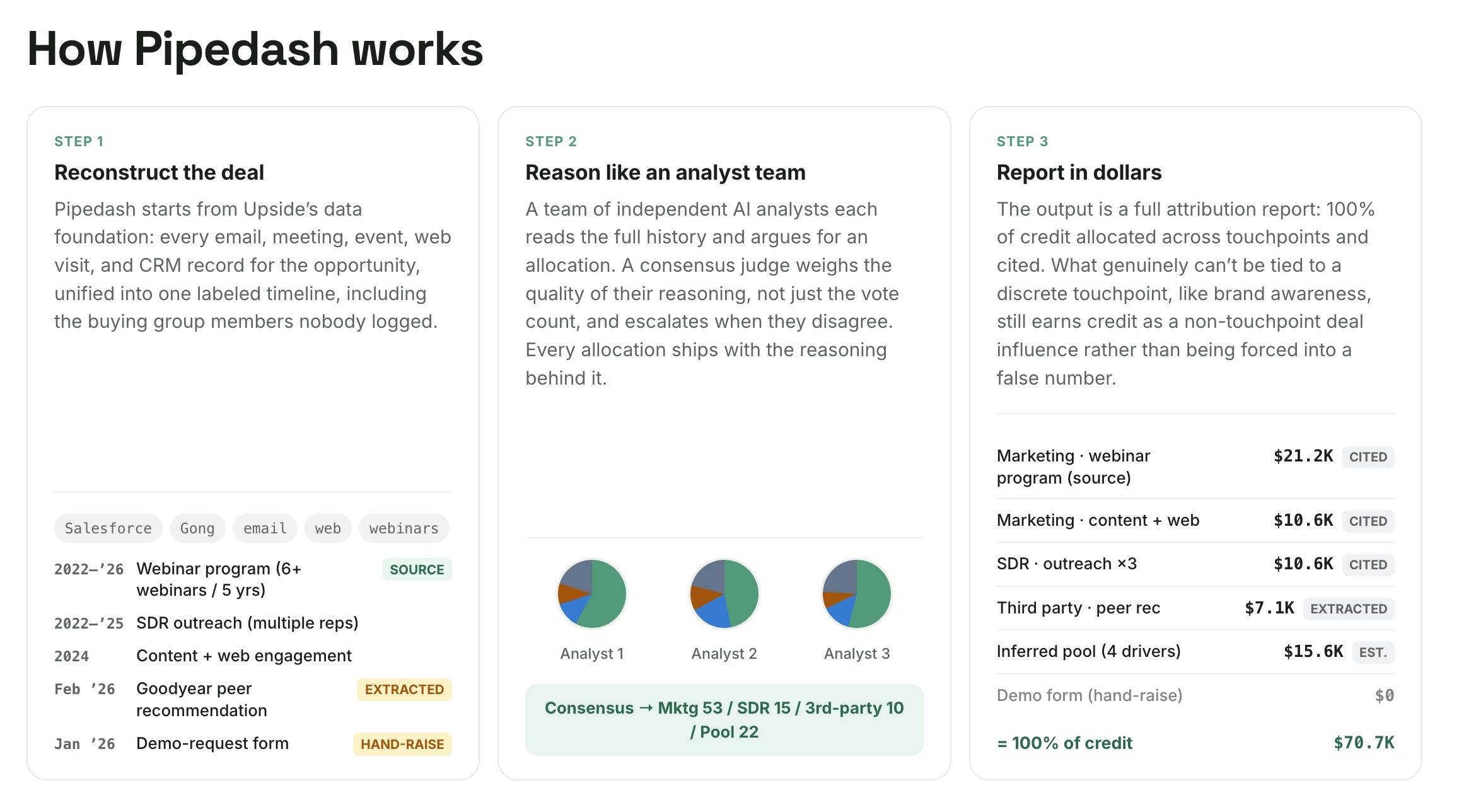
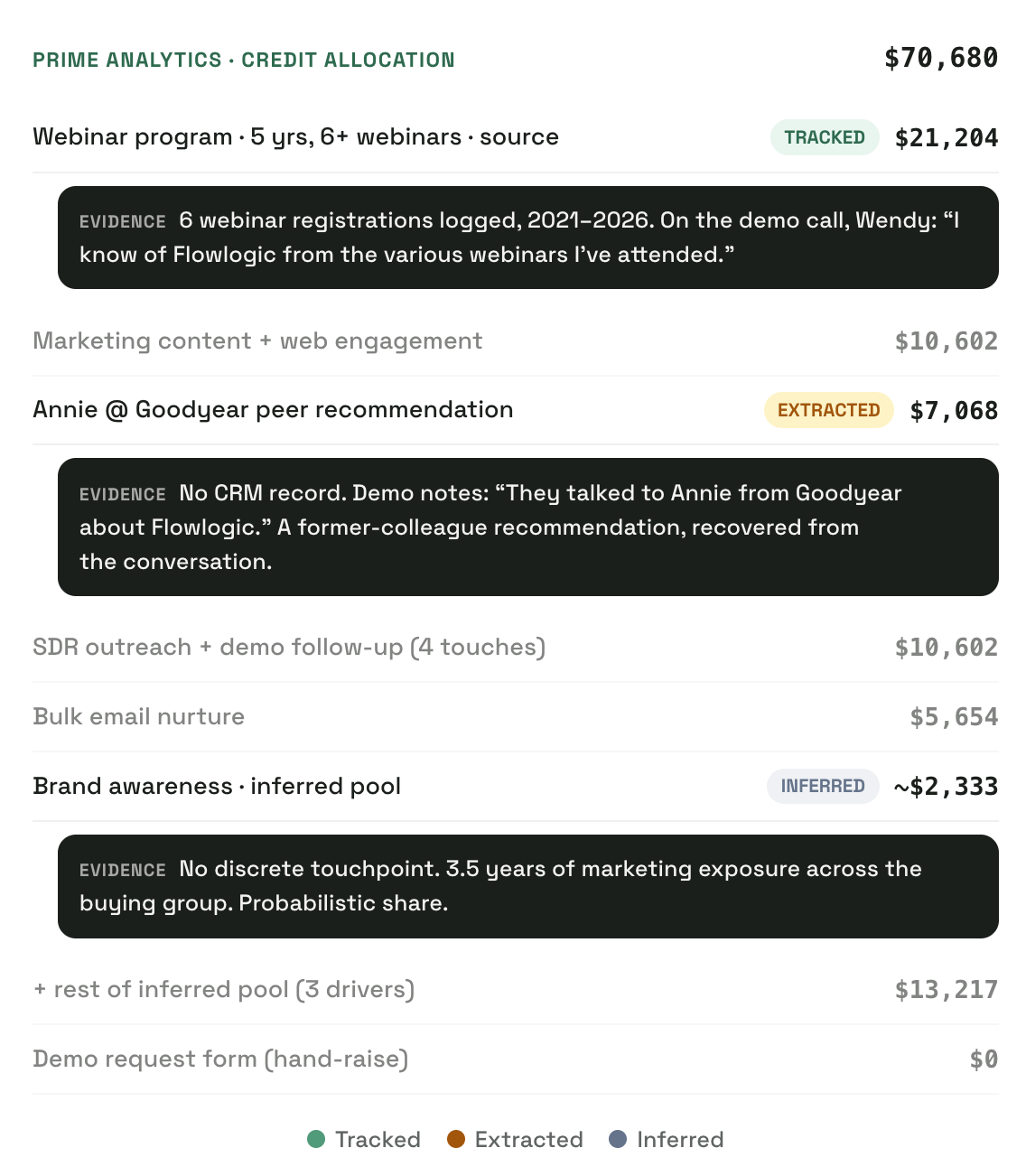
Pipedash works like a jury: a panel of independent AI analysts each reads the full deal history and argues for an allocation, a judge weighs their reasoning, and every dollar ships with a citation. It baffles even the skeptics. Sales leaders at one enterprise customer pulled up deals they knew personally to stump it, and on one, the system surfaced that the connection came through an alumni association. Their words: “That was it! How did it know?!”
So attribution is solved. Which brings us to the real problem, the one no model was ever going to fix.
Everyone hates attribution because it gets used as a goal. It never should be.
“When a measure becomes a target, it ceases to be a good measure.” That’s Goodhart’s law, and it should be stapled to every attribution dashboard ever shipped.
Think about why attribution fights get so ugly. It was never really about the math. It’s that credit became comp: the “sourced by” field decides marketing’s budget, the SDR’s bonus, whose headcount survives planning season. So everyone games the inputs and inflates their claims, and you get the thread every CEO knows by heart: marketing claims $33M, SDRs claim $41M, sales claims $20M, partnerships claims $12M... and there’s $54M of real pipeline.
People don’t hate attribution. They hate what goaling on it turns them into.
The collaboration cost is even worse. At Branch, our single best source of new deals was VIP dinners that marketing organized and SDRs filled with 1:1 invites. Goal each team on their credit split, and the SDR stops inviting prospects to marketing’s dinner, because helping might shrink their own number. Your best program dies first, and it dies silently.
But here’s the twist: now that attribution actually works, evidence-based allocation can’t be gamed. You can’t argue with a citation. That should be great news, but it turns out some teams wanted the weapon more than the truth. They don’t want attribution, they want a predictable metric they can goal on. When someone says “this doesn’t look right,” listen closely: sometimes it means “this doesn’t let us look like we’re doing a good job.”
Attribution is a diagnostic, not a target. It exists to teach you what drives revenue, not to decide who gets paid.
Three more problems
1. It’s expensive to run. For now. Reasoning over thousands of touchpoints per deal with a panel of AI analysts costs real compute. We’re making it cheaper by pre-organizing the data and encoding it as a knowledge graph, so every run starts from structure instead of chaos. But today, honestly, you don’t run this on every deal every morning.
2. Not everyone wants attribution. Some people want a tool that shows them they did well. A mirror, not a microscope. No technology fixes that.
3. Deal-level truth is slow. Big deals take a year or more, so even perfect attribution tells you what worked twelve months ago - and it can help you make smart investment decisions but it can not help you understand if your team is doing well now.
So here’s how to actually use it
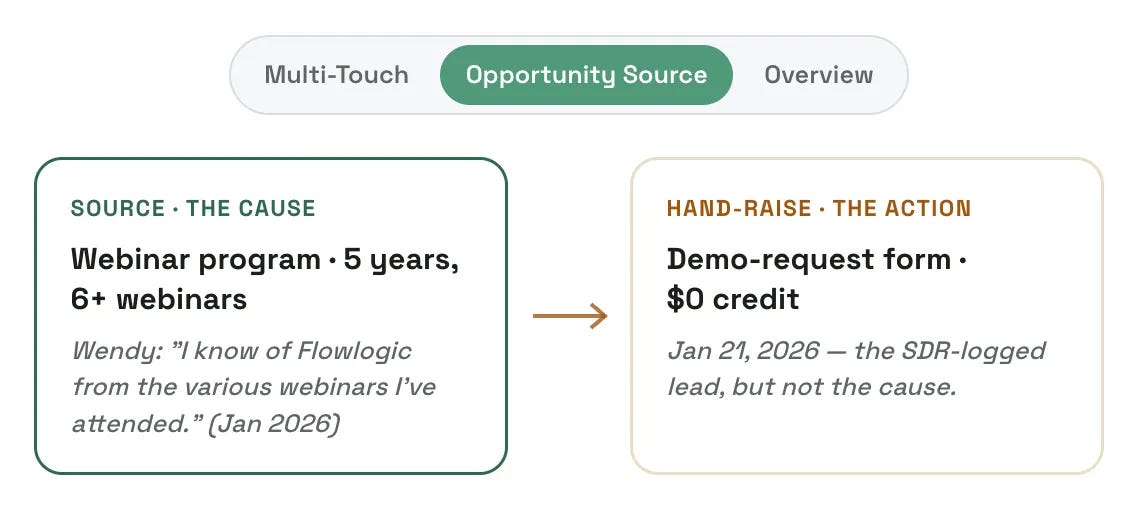
Do attribution at a very high level. Channel, program, quarter. Where does the next $100K go, what do we kill, what do we revive. Ethan Smith’s team at Graphite found $10M+ in hidden referral revenue this way and restarted the events program that last-touch had murdered.
Never goal on attribution, goal on measured leading indicators instead. Use attribution to learn what drives revenue, then comp people on the controllable inputs it points to (new pipeline created after an event, pipeline velocity, number of leads that turned into stage 2 pipeline etc ). Never on “your team’s share of the credit.”
Put both on the same clean, comprehensive data layer. One reconstructed record of what happened, shared by every team, feeding both your attribution and your goals’ measurement and all the campaigns that help you win along the way.
If you’re wrestling with any of this, especially the “my CRO wants to comp on sourced pipeline” version, DM me or comment below. I’d genuinely love to hear how you’re thinking about it.